Blessed - Bible Verse & Prayer
- 4.6
- Rating
- 1.00M
- Installs
- Free
- Price

 Analysis by App-foxy
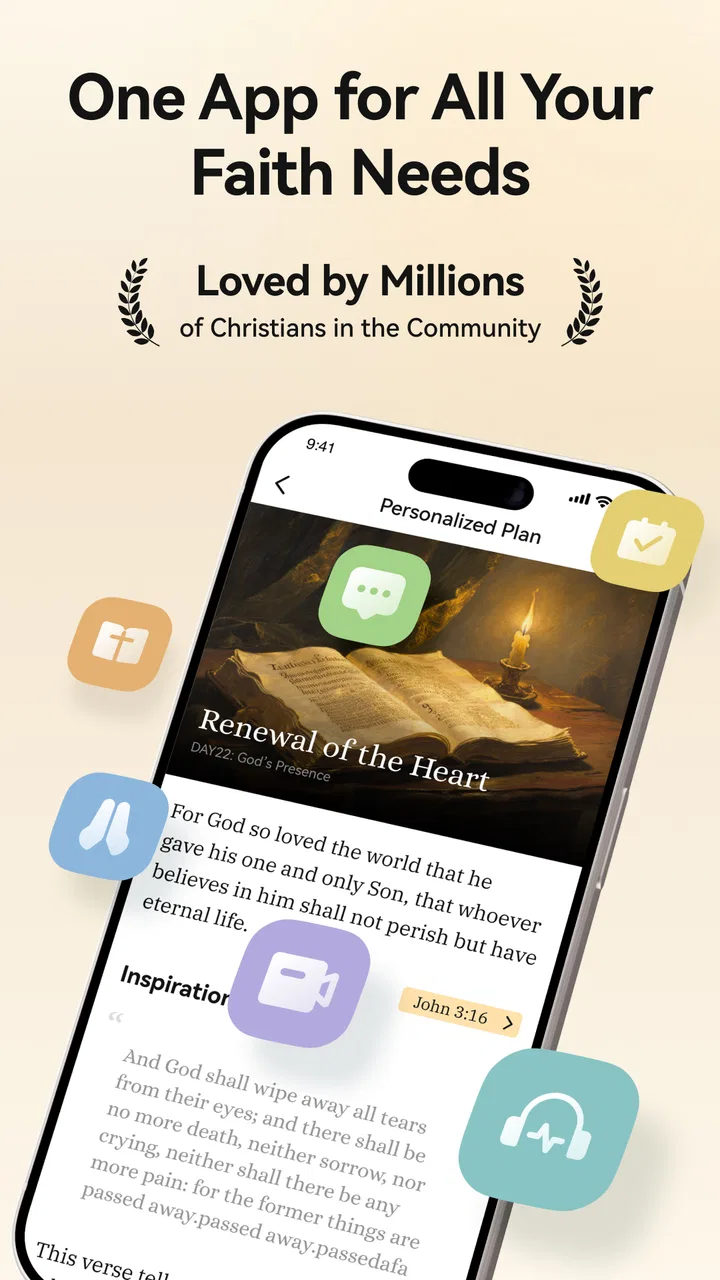
I approached Blessed - Bible Verse & Prayer as a quiet daily companion rather than another app to check constantly. It belongs to the Books & Reference category, but its real purpose is more personal: helping me create a small, repeatable space for Bible reading, prayer, and reflection. The central idea is a six-step daily journey toward a closer connection with God, and that structure gives the experience more direction than simply opening a Bible app and choosing a passage at random.
After spending time with it, my impression is that Blessed works best when I treat it as a gentle routine. It does not replace a complete study Bible, a church community, or a thoughtful conversation with a pastor. Instead, it gives a simple starting point for people who want to pause during a busy day. I found the app most useful when I opened it with a specific intention: a few minutes in the morning, a reset during lunch, or a calmer ending to the evening.
What the six-step format feels like in everyday use
The six-step approach is the feature that shapes the whole experience. Rather than presenting an enormous library and leaving me to decide where to begin, Blessed turns a devotional moment into a sequence. That can be reassuring for someone who feels unsure about how to build a prayer habit. The app gives the session a beginning, a middle, and a natural stopping point, which makes it easier to fit into an ordinary day.
You May Also Like

 Blood Strike: 2.5 Anniversary
Blood Strike’s Loadouts Turn Every Drop Into a Tactical Gamble
A close look at Blood Strike’s custom loadouts: how fast access to signature weapons reshapes its battle royale rhythm, rewards preparation, and narrows the gap between fights.

 Pandora - Music & Podcasts
Pandora’s Music Is Easy to Start, but Harder to Recover
Pandora’s strength is its low-effort path from a seed to a station. Its weak spot is how much confidence it asks you to place in connection, setup, and quiet recovery.

 8 Ball Pool
 Is Built on Rivalries, Rematches, and Routine
A close look at the rivalries, rematches, shared routines, and unanswered safety questions that turn a quick pool match into a persistent mobile community.

 Samsung Music
’s Quiet Strength Is Playing What You Already Own
Its reach comes less from spectacle than from dependable access to a personal library. That simplicity is both the app’s strongest retention engine and its ceiling.

 AccuWeather: Weather Radar
AccuWeather Review: A Quick, Clear Forecast for Everyday Decisions
For everyday plans, the best forecast is the one you can understand quickly. AccuWeather makes rain timing, radar, and local conditions easy to act on, with a few trade-offs.

 Hill Climb Racing
Why Hill Climb Racing Still Turns Crashes Into One More Run
A tiny car, a bumpy hill and one more upgrade: Hill Climb Racing keeps resurfacing because its simple chaos makes every near-miss feel personal.
More From Our News Desk



A realistic use case is a short morning routine before work. I can sit with a cup of coffee, move through the daily material, and use the sequence as a prompt to slow down before opening email. The value is not that the app magically creates concentration; notifications, tiredness, and a crowded schedule can still get in the way. The value is that I do not have to spend the first few minutes deciding what to read or how to organize the moment.
I also found the format suitable for people returning to faith or trying to become more consistent. A full study plan can feel demanding when a person is already struggling to make time. Blessed presents a smaller commitment. That makes it less intimidating, although users who want long-form commentary, historical context, or detailed cross-references may quickly feel that it is too light.
One useful habit is to avoid treating the six steps like a task list that must be completed as quickly as possible. I got more from the app when I paused after a verse or prayer prompt and allowed myself to reflect before moving forward. The sequence is helpful as a framework, but its benefit depends on how deliberately I use it. Rushing through every screen turns a reflective tool into another piece of daily digital housekeeping.
Who is likely to appreciate it
Blessed is a good match for someone who wants a straightforward Bible verse and prayer app with a guided rhythm. It may also suit a person who has tried reading plans but found them too complicated, or someone who wants a small spiritual practice that can travel with them. The Everyone content rating makes it approachable for a broad audience, though individual families will still want to decide how and when younger users should use any devotional app.
I would be more cautious about recommending it as the only Bible resource for serious study. Readers who compare translations, examine original-language notes, follow extensive topical references, or prepare lessons will probably prefer a dedicated study Bible or a more specialized reference tool. Blessed has a different strength: reducing friction at the moment when a person wants to begin.
It is also not the right choice for someone who dislikes guided devotional formats. The six-step journey is central to the identity of the app, so a user looking for a completely open-ended reading experience may find it restrictive. In that situation, a conventional Bible reader with search, bookmarks, and multiple reading views would offer more control.
Trust starts with what the app visibly asks from me
When I review an app connected to personal beliefs, I pay attention to more than its reading material. Trust also comes from the choices visible during use: what the app asks me to do, whether an account feels necessary, how clearly paid options are presented, and whether I can decide how much of my personal life to bring into the experience. Those details matter because devotional routines can become emotionally meaningful, even when the app itself remains simple.
Blessed is developed by Everblessed Technology Inc. and is available as a free app. That makes it easy to try without making a payment at the starting point. At the same time, the presence of in-app purchases means I would not assume that every optional part of the experience is included at no cost. The listed purchase range runs from $0.99 to $456.00 per item, so I would review any purchase screen carefully before confirming anything.
That price range is especially important for families sharing a device or for anyone who hands a phone to a child. I recommend keeping purchase authentication enabled at the device level and reading the wording on each offer rather than tapping through quickly. This is not a criticism of the devotional concept; it is a practical boundary that protects the user’s choice when a free app includes optional paid items.
The app has reached more than one million installs and carries a 4.7 average from around 38 thousand ratings, with roughly 5.3 thousand written reviews. Those figures suggest that many people find the format useful, but popularity is not a substitute for checking whether the experience fits my own expectations. A large audience cannot tell me whether I will prefer guided steps over an open Bible reader, or whether the available purchase choices suit my budget.
Account decisions and personal boundaries
One of the questions I would ask before settling into Blessed is whether I want to connect a personal identity to my devotional routine. If the app presents account creation, I would look at whether it is required for the core reading experience or simply offered for convenience. I would also check what can be used without creating a profile. Keeping an app-based routine separate from my wider online identity can be a sensible choice when I only want reading and prayer prompts.
I would apply the same care to optional fields, profile settings, and any request to share activity. A devotional app can feel private because the content is personal, but privacy is still shaped by ordinary user choices. I would avoid adding information that is not needed for the way I intend to use the app. If I only want a daily moment of reflection, I do not need to turn that into a detailed personal record.
Another practical step is to revisit device permissions after installation. I look for permissions that are clearly connected to the app’s purpose and decline anything I do not understand or need. If a feature later requires a permission, I prefer to make that decision at the moment it becomes relevant. This keeps the experience more deliberate and makes it easier to notice what I am agreeing to.
I also recommend checking the operating system’s privacy dashboard from time to time. That is a better way to review actual device access than relying on assumptions about what a category of app normally does. If a user changes their mind, the operating system settings are the first place to look for permission controls, notification choices, and account-related access.
Where personal data deserves extra attention
The most sensitive moments are not necessarily the Bible reading screens. They are the points where a user might enter a prayer request, write a reflection, save a personal note, or connect the app with another service. Anything that describes health, family conflict, finances, grief, or private beliefs should be treated as sensitive before it is typed into any app.
My rule would be simple: use the app for reflection, but do not enter identifying details unless I have a clear reason and understand where that information is stored. A prayer can be meaningful without naming a person, workplace, address, or medical condition. This approach preserves the spiritual purpose while reducing unnecessary exposure.
I would also be careful with sharing features. If the app offers a way to send a verse or prayer to someone, I would check the destination before confirming. A link or message can reveal more context than intended, particularly if it includes a personal note or a visible account name. Sharing a general verse is different from sharing a private reflection, and I would keep those two actions separate.
Notifications deserve a similar review. A reminder can help establish a routine, but a lock-screen message may reveal that I use a prayer or Bible app to anyone looking at my phone. I prefer notifications that are discreet and limited to what I need. On a shared or work device, turning off previews can be the better trade-off, even if it means I have to open the app manually.
These are not reasons to avoid Blessed. They are habits I would use with any app that touches personal beliefs. The strongest privacy decision is often made before entering information: deciding what belongs in the app and what is better kept in a private journal, conversation, or offline note.
How Blessed compares with familiar alternatives
Compared with a standard Bible app, Blessed feels more guided and less like a reference shelf. A typical Bible reader is usually better when I already know the book, chapter, or topic I want to find. It may also be preferable for long reading sessions and detailed study. Blessed has the advantage when I want the app to shape a short devotional moment instead of asking me to design one.
Compared with a paper devotional, the app is more portable and easier to open during an unexpected gap in the day. A printed book can feel calmer because it removes the distractions of a phone, though it cannot offer the same convenience when I am away from home. My choice would depend on whether I need accessibility and portability or want a deliberately screen-free practice.
Compared with a general meditation app, Blessed is clearly aimed at Christian prayer and Bible engagement rather than broad relaxation. That focus is a strength for users who want faith-specific material. It is not a neutral mindfulness tool, and someone seeking breathing exercises, secular prompts, or a wide range of wellness programs would be better served elsewhere.
The trade-off is clear: Blessed reduces the number of decisions I need to make, but it also gives me less freedom than a fully open reading platform. I would choose it for consistency and simplicity, not for the deepest research tools or the widest customization.
Practical ways to get more from the routine
My first tip is to choose a stable moment rather than waiting for a completely free day. A short session attached to an existing habit, such as after breakfast or before putting the phone on charge, is easier to maintain than an ideal routine that requires perfect silence. The six-step structure works particularly well when the user protects a modest amount of time instead of promising an unrealistic devotional block.
My second tip is to use different settings for different situations. In the morning, I might move through the journey with a practical intention for the day. In the evening, I might slow down and focus on gratitude or review. The app does not need to become a diary for this to work; a single mental question before starting can make the session more personal without adding extra data to the device.
My third tip is to separate discovery from study. I can use Blessed to encounter a verse or prompt, then switch to a trusted Bible resource if I want broader context. That prevents me from demanding that one small app perform every role. It also helps me notice when a verse needs careful interpretation rather than a quick emotional reaction.
Finally, I would review purchases and notifications after the first few sessions, not just during installation. Once I know which parts of the experience I actually use, I can decide whether optional extras are worthwhile and whether reminders support my routine or interrupt it. This is a better test than paying immediately because the app’s value depends on sustained use, not on the first impression.
Performance expectations and version context
The current version is 3.3.5, and the app supports devices running Android 7.0 or later. That minimum makes it accessible to many older Android phones, which is useful for people who do not replace devices frequently. Still, compatibility alone does not guarantee that every phone will feel equally smooth. Screen size, available storage, battery settings, and the phone’s notification behavior can all affect a daily reading routine.
If reminders do not appear consistently, I would first check battery optimization and notification permissions rather than assuming the devotional content is missing. Some Android phones restrict background activity aggressively. If the app feels crowded on a smaller screen, increasing system text size may improve readability, although that can change how much content fits on each screen.
I also prefer installing updates through the normal app store process and checking the version after an update if something looks different. This is especially sensible when an app includes account controls or purchases, because interface changes can move settings that I previously knew how to find. Keeping the operating system and store account secure matters just as much as choosing a trustworthy app.
My cautious verdict for different kinds of users
After using Blessed, I see it as a focused devotional companion rather than a complete Bible library. Its strongest quality is the way the six-step journey turns an abstract intention into a manageable daily action. I can recommend it to a friend who wants a simple Christian routine, appreciates guidance, and is willing to review optional purchases and privacy choices carefully.
I would not recommend it as the sole tool for academic Bible study, extensive scripture comparison, or users who want a completely customizable reading environment. I would also tell a privacy-conscious friend to keep personal entries general, inspect permissions through the phone’s settings, control notification previews, and avoid treating a free download as proof that every part of the app is free.
The app is free to start, rated for Everyone, and has attracted a substantial user base, but the most important question is personal: does the guided journey help me return to prayer and scripture, or does it feel like another obligation on my screen? For me, it works when I use it intentionally and keep clear boundaries around purchases, notifications, accounts, and private information. The best reason to try Blessed is its low-friction daily structure; the best reason to pause first is the need to stay alert to optional choices and sensitive data.
In that limited but useful role, Blessed earns a place among the easier ways to begin a regular devotional habit. I would download it for a guided starting point, not because it replaces deeper resources. Used with that expectation, it can make a few quiet minutes feel more purposeful without asking the user to build an elaborate system around them.
FAQs for Blessed - Bible Verse & Prayer
01What features does the Blessed - Bible Verse & Prayer app offer?
The Blessed app provides daily Bible verses, personalized prayer plans, and a community feature for sharing prayers with others. Users can set reminders for daily devotionals and explore various Bible translations. Additionally, the app offers audio versions and meditation guides to enhance your spiritual journey.
02Is the Blessed app free to use, or does it require a subscription?
The Blessed app is free to download and offers several features at no cost. However, it also includes premium options through a subscription model, providing access to exclusive content like advanced prayer plans, ad-free usage, and additional Bible study resources. Users can choose to upgrade for a more comprehensive experience.
03Can I use the Blessed app offline?
Yes, the Blessed app allows users to download certain content for offline use. This includes daily verses, saved prayers, and selected Bible translations. However, some features, such as community interactions and new content updates, require an internet connection to access fully.
04How does the Blessed app ensure user privacy and data security?
The Blessed app takes user privacy seriously, implementing encryption and secure servers for data storage. Users have control over their profile settings and what information is shared. The app complies with major privacy regulations, ensuring that personal data is protected and used responsibly.
05Are there any community features in the Blessed app?
Yes, the Blessed app includes community features where users can share prayers, join prayer groups, and support others in their spiritual journey. This fosters a sense of connection and encouragement among users. Community guidelines ensure that interactions remain positive and respectful.
Pros
- User-friendly interface for easy navigation.
- Daily reminders for prayers and verses.
- Customizable themes for personalization.
- Offline access to saved content.
- Wide range of translations available.
Cons
- Contains ads in the free version.
- Limited features without premium.
- Occasional app crashes reported.
- Requires account for full access.
- Some users find notifications intrusive.

Blessed - Bible Verse & Prayer
Gallery